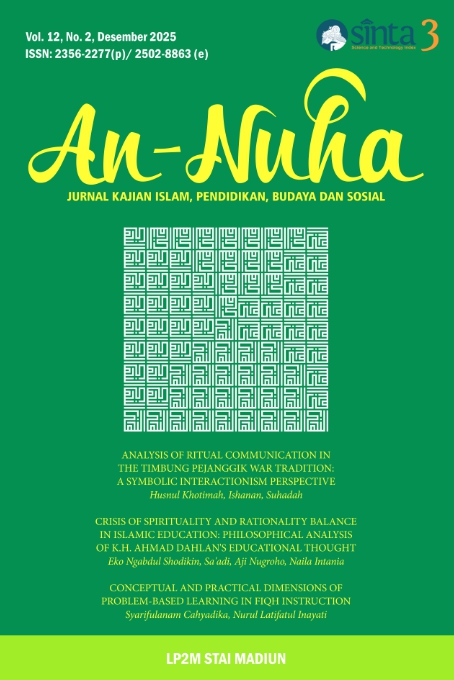
Analysis of Ritual Communication in The Timbung Pejanggik War Tradition: A Symbolic Interactionism Perspective
DOI:
https://doi.org/10.64810/annuha.v12i2.846Keywords:
Timbung War, Symbolic Interactionism, Cultural Tradition, Ritual Communication, Sasak CommunityAbstract
This study examines the symbolic meaning and cultural communication practices in the Timbung war ritual tradition in Pejanggik, Central Lombok. This tradition, rooted in historical values and ancestral heritage, is an important part of social identity, religious values, and community harmony. This study aims to analyze the symbolic interaction, function, and meaning contained in each element of the ritual through a symbolic interactionism approach. The method used is qualitative with data collection through semi-structured interviews with traditional leaders, religious leaders, the community, and cultural actors. The results of the study show that the Timbung War functions as a communication ritual that strengthens social cohesion, preserves ancestral values, and integrates Islamic teachings through prayer and togetherness. Each symbol in the ritual, such as bamboo, water, offerings, and coordinated movements, contains meanings of purity, unity, protection, and respect for ancestors. The study concludes that the Timbung War is a cultural tradition that remains alive and preserved through regeneration and the active role of the community amid the tide of modernization. The findings of this study contribute to efforts to preserve local culture, strengthen community identity, and can be used as a reference in the development of cultural education programs and tradition preservation policies based on community participation.
Downloads
References
Aji, Wahyu Trisno. “From Melody to Values: The Gendang Beleq Musical Art in Building Community Values in Daily Life and Its Ability to Face the Challenges of the Times (Julaeha, 2024). According to Britannica, the Daily Life of a Region’s Society Can Be Identified Through…” 1, no. 2 (2024): 76–94. https://doi.org/10.54373/ethno.v1i2.41.
Akbar, Ahmad Naufal, Masyhuri, Nursapti, and Suud. “The Process of the Ngorek Tradition in the Nyongkolan Ceremony among the Sasak Community of Tanak Awu Village, Pujut District, Central Lombok Regency.” Entita: Journal of Social Science Education and Social Sciences 6, no. 2 (2024): 7–11. https://doi.org/10.19105/ejpis.v6i2.15823.
Anam, Fikri Khairul. “Symbols of Islamic Values in the Ritual Tradition of Perang Timbung in Pejanggik Village, Central Lombok.” Jurnal Global Ilmiah, 2024. https://doi.org/10.55324/jgi.v1i5.51.
Anatasya, Ervina. “The Role of Cultural and Civic Literacy in Efforts to Preserve Local Indonesian Culture in the Era of the Industrial Revolution 4.0.” 2, no. 1 (2024): 253–264. https://doi.org/10.51903/bersatu.v2i1.552.
Awaludin, Muhammad. “The Sasak Rowot Calendar (Traditional Calendar of the Sasak Community).” AL-AFAQ Journal of Falak Science and Astronomy, Faculty of Sharia, State Islamic University (UIN) Mataram 1, no. 1 (2019): 89–101. http://dx.doi.org/10.20884/1.jdh.2010.12.3.117.
Bastin, Rohan. “Sacrifice, Sovereignty, and the …” 20, no. 3 (1969): 395–406.
Carter, Michael J., and Celene Fuller. “Symbols, Meaning, and Action: The Past, Present, and Future of Symbolic Interactionism.” Current Sociology, 2016. https://doi.org/10.1177/0011392116638396.
Ahmadi, Dadi. “Symbolic Interactionism: An Introduction.” Mediator: Journal of Communication 9, no. 2 (2008): 301–316. https://doi.org/10.29313/mediator.v9i2.1115.
Universitas Dwipa Bali. “Exploration of Ritual Communication in Weaving Participation and Harmony in the Traditional Village of Penglipuran.” INNOVATIVE: Journal of Social Science Research 5 (2025): 1742–1752. https://doi.org/10.31004/innovative.v5i2.18176.
Fitria, Rini, and Rohmad Fadli. “Bugis Ethnic Rituals in Bengkulu City.” Al-Hikmah Journal, IAIN Pontianak, 2017: 103–118. https://jurnaliainpontianak.or.id/index.php/alhikmah/article/view/825.
Lubis, Faris Yusuf. “The Roles of Youth in Preserving Local Cultures to Develop Tourism in Sabang City.” Journal of Environmental and Development Studies 2, no. 1 (2021): 19–27. https://doi.org/10.32734/jeds.v2i1.6194.
Mustira, Sheila, and Detya Wiryany. “Identity and Cultural Image of Acehnese Society.” 9 (2025): 48–63. https://doi.org/10.51544/jlmk.v9i1.5921.
Muthi, Shulbi, Sabila Salayan, and Universitas Widya Mataram. “The Meaning of Ritual Communication in the Sea Alms Tradition at Parangkusumo Beach in Preserving Cultural Values.” 4, no. 2 (2021): 162–175. https://doi.org/10.24042/komunika.v4i2.9324.
Nafis, Mufidin, Jeremia Steven Tambunan, and Sahru Azkiya Putra Ramadhan. “Youth in Preserving Local Culture Facing the Role of Globalization and Modernization.” 2025.
Niron, Eusabius Separera. “Urban Spatial Planning Politics in Kupang City Based on Physical and Socio-Cultural Identity.” Jurnal Caraka Prabu 7, no. 1 (2023): 39–64. https://doi.org/10.36859/jcp.v7i1.1503.
Noortyani, Rusma, Fatchul Mu’in, and Rizky Amelia. “Symbolic Communication in the Traditional Wedding Rituals of the Banjar Ethnic Community, Indonesia.” ISVS E-Journal 10, no. 10 (2023): 154–178. https://doi.org/10.61275/ISVSej-2023-10-10-11.
Nurmalinda. “Symbolic Interactionism in Ritual Medicine Ceremonies of the Malay Community in Riau Province.” Journal of Urban Society’s Arts 8, no. 2 (2022): 98–110. https://doi.org/10.24821/jousa.v8i2.5719.
Nuruddin, Nuruddin, and Nur Nahar. “Acculturation of Islamic Religious Practices in the Perang Timbung Tradition in Pejanggik Village, Central Lombok.” JISIP (Journal of Social and Educational Sciences) 6, no. 2 (2022): 3757–3767. https://doi.org/10.58258/jisip.v6i2.2964.
Padli, Erwin, Mohamad Khairi bin Haji Othman, Hafizah Hajimia, Ahmad Sanusi, and Ahmad Aprillah. “Discourse of Tradition and Religious Education: Islamic Educational Values in the Perang Timbung Cultural Practice.” Tafkir: Interdisciplinary Journal of Islamic Education 6, no. 2 (2025): 420–435. https://doi.org/10.31538/tijie.v6i2.1807.
Saputera, Elham. “Analysis of the Symbolic Meaning of the Cahapan Tradition in the Ogan Community of Muara Saeh Village, Muara Jaya District, Ogan Komering Ulu Regency.” 2 (2021): 15–28. http://journal.unbara.ac.id/index.php/JM/article/view/1574/1039.
Sari, Henny Puspita, and Yanti Haryanti. “Symbolic Meanings in the Sedekah Bumi Traditional Ceremony of Pelem Village, Gabus District, Grobogan Regency.” Jurnal Indonesia: Management of Informatics and Communication 5, no. 1 (2024): 974–982. https://doi.org/10.35870/jimik.v5i1.617.
Suhadah, Deddy Mulyana, Pawit M. Yusup, and Nuryah A. Sjafirah. “Pilgrimage Sites as Magnets of Interfaith Tolerance: The Case of Kemaliq Lingsar in Indonesia.” International Journal of Religious Tourism and Pilgrimage 10, no. 3 (2022): 14–27. https://arrow.tudublin.ie/ijrtp/vol10/iss3/3/.
Sulaeman, Sulaeman, Muhammad Rijal, Mahdi Malawat, and Idrus Sere. “The Symbolic Communication of the Ukuwala Mahiate Ritual of the Indigenous People of Mamala, Moluccas, Indonesia.” Journal of International Migration and Integration 22, no. 2 (2021): 385–403. https://doi.org/10.1007/s12134-019-00753-1.
Wijaya, Tomy, Siska Amelia, and Farida Ratu Wargadalem. “Local Wisdom: The Role of the Kebagh Dance in Shaping the Cultural Identity of the Besemah Ethnic Group.” Jawi 8, no. 1 (2025): 61–76. https://doi.org/10.24042/00202582720900.
Downloads
Published
How to Cite
Issue
Section
License
Copyright (c) 2025 Husnul Khotimah, Ishanan Ishanan, Suhadah Suhadah

This work is licensed under a Creative Commons Attribution-ShareAlike 4.0 International License.
Copyright Notice
Seluruh materi yang terdapat dalam situs ini dilindungi oleh undang-undang. Dilarang mengutip sebagian atau seluruh isi situs web ini untuk keperluan komersil tanpa persetujuan dewan penyunting jurnal ini.
Apabila anda menemukan satu atau beberapa artikel yang terdapat dalam An Nuha yang melanggar atau berpotensi melanggar hak cipta yang anda miliki, silahkan laporkan kepada kami, melalui email pada Priciple Contact.
Aspek legal formal terhadap akses setiap informasi dan artikel yang tercantum dalam situs jurnal ini mengacu pada ketentuan lisensi Creative Commons Atributs Share Alike (CC BY-SA).
Semua Informasi yang terdapat di An-NUHA bersifat akademik. An-NUHA tidak bertanggung jawab terhadap kerugian yang terjadi karana penyalah gunaan informasi dari situs ini.